Seven Sleepers
Jeremias, 26 June 2026
Most Americans are familiar with the Pennsylvania Dutch contribution to weather lore known as Groundhog Day. But that is only one of several dates in the Pennsylvania Dutch calendar associated with seasonal folklore.
Tomorrow, June 27, is recorded as 7 Schläfer ‘Seven Sleepers’ in old Pennsylvania Dutch almanacs, a day rooted in an ancient Christian legend. According to tradition, seven young Christians from Ephesus sought refuge in a cave to escape Roman persecution. There they fell into a deep sleep, only to awaken unharmed miraculously many years later.
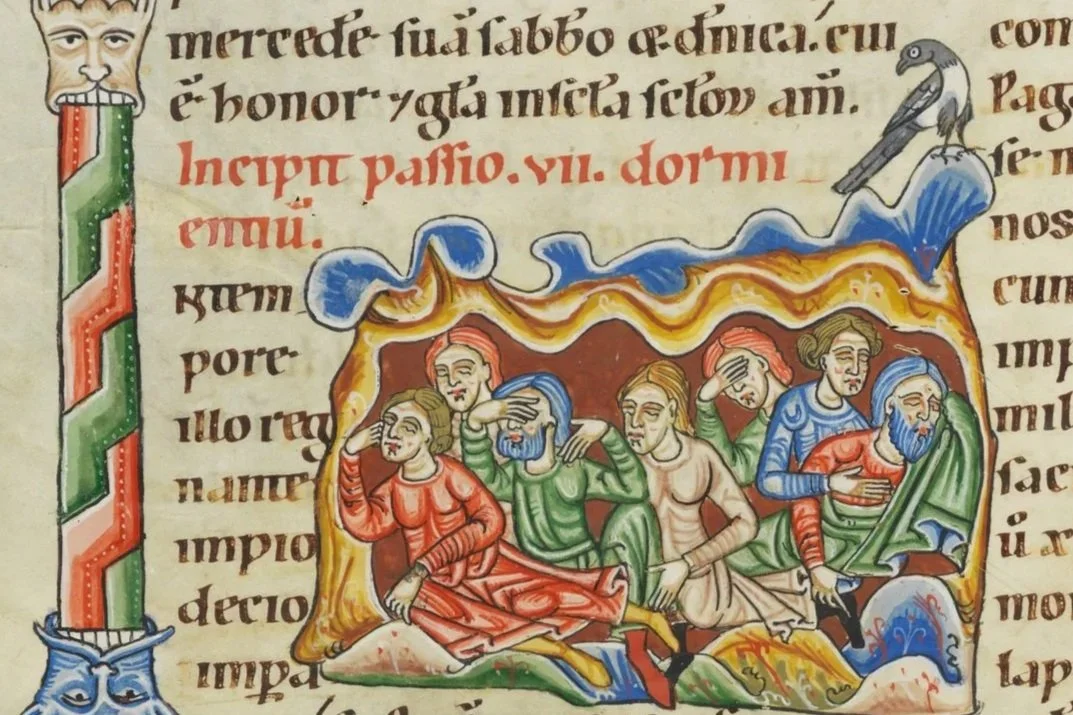
Seven Sleepers from the Passionary of Weissenau (1170-1200)¹
In German-speaking Europe, the feast day of the Seven Sleepers was linked to a weather belief: whatever weather occurred on June 27 would continue for the next seven weeks. A sunny Seven Sleepers promised a pleasant summer, while rain meant weeks of damp weather.
Curiously, this weather tradition does not seem to have taken root among the Pennsylvania Dutch.² Perhaps it was overshadowed by another weather-predicting day just a few days later on our calendar. July 2 is Mariche iwwer der Barig ‘Mary over the Mountain,’ commemorating the Visitation, when the pregnant Virgin Mary traveled to visit her relative Elizabeth, who was likewise expecting John the Baptist.
Pennsylvania Dutch tradition said that whatever weather occurred on Mariche iwwer der Barig would continue until Mary’s return on August 15, the Assumption (Mariche Himmelfahrt). Other versions of the belief predicted only the weather on those two days. If Mary crossed the mountain in sunshine on July 2, she would return to the opposite (rain) on August 15, and vice versa.³
Whatever the reason, Siwwe Schlaefer ‘Seven Sleepers’ acquired a different significance in Pennsylvania Dutch folklore.
Rather than forecasting the weather, Siwwe Schlaefer became associated with the harvest. Traditional wisdom advised farmers to sow buckwheat on that day. They were also encouraged to bend over the tops of their onions to encourage larger bulbs. And if chestnut trees bloomed on Seven Sleepers, the autumn chestnut harvest would be exceptionally abundant.
These beliefs remained into the early twentieth century. In 1904, for example, the Lebanon Daily News reported chestnut trees blooming on Seven Sleepers and confidently predicted a bumper chestnut crop.⁴ And later in October, those predictions proved correct — the first page of the Lebanon Daily News proclaiming the boom crop.
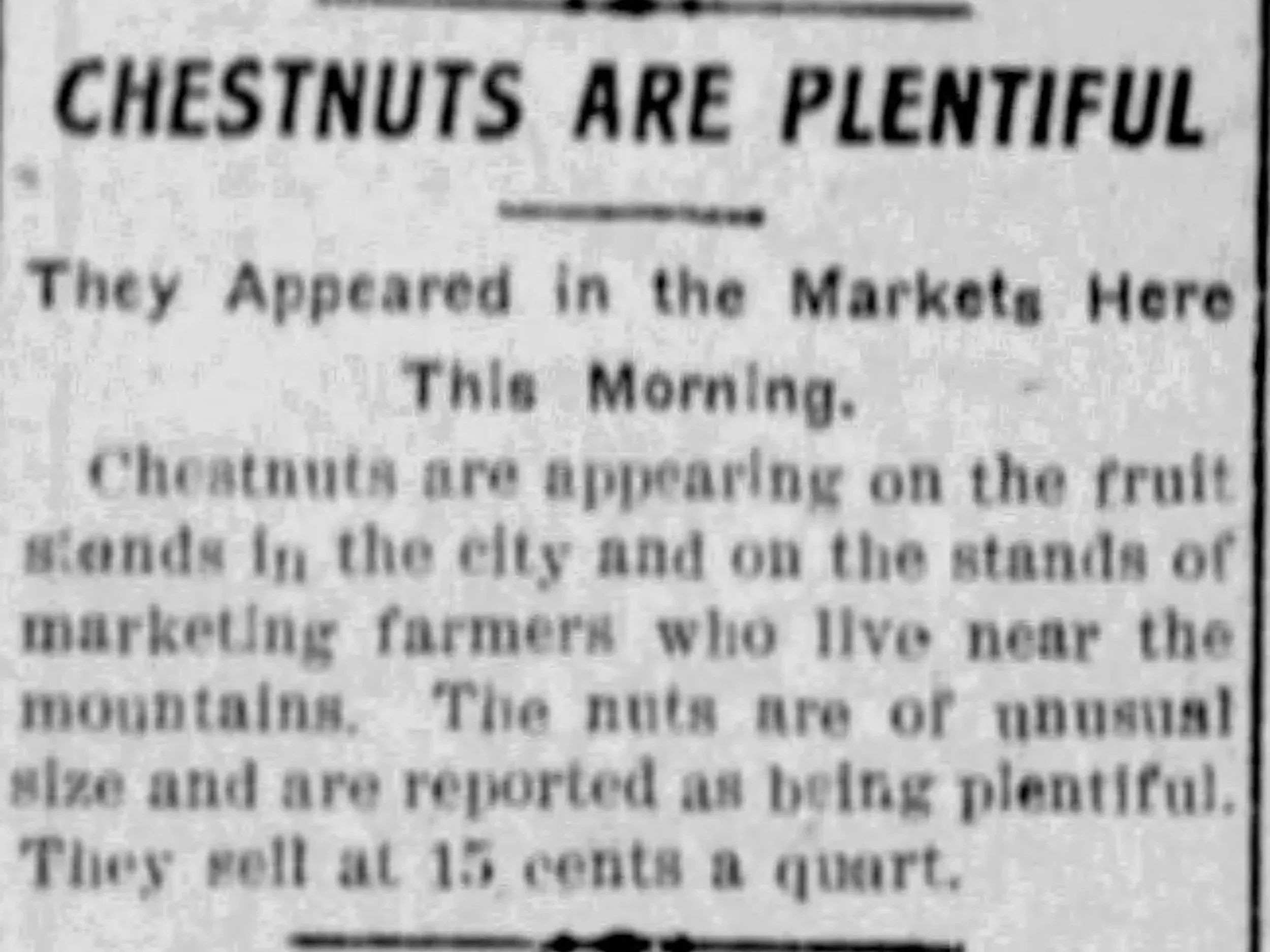
Plentiful chestnuts, Lebanon Daily News, October 1, 1904, p. 1
By 1914, however, signs of change to Seven Sleepers were happening. A community correspondent in Perry County observed that farmers abandoned the old custom of sowing buckwheat on Seven Sleepers, preferring to plant the crop when sowing oats for better yields.⁵
A more upsetting change is the fate of the American chestnut. Once being one in every four trees in the Pennsylvania Dutch country, the American chestnut has been devastated by blight — incidentally discovered in 1904, the year of Lebanon County’s chestnut harvest boom. Today, mature chestnut trees are rare sights in their native range. Whether chestnut blossoms appear on Siwwe Schlaefer or not, the abundant harvests anticipated by earlier generations no longer happen.
Traditions like Seven Sleepers remind us how closely our ancestors observed the natural world with wonder and curiosity. Long before weather apps, we relied on generations of these observations to make sense of the world around us. We can also look back and see what we’ve lost. We’ve lost our curiosity with nature (some more than others) and we’ve also lost the chestnut harvest. Without onions and buckwheat at hand, how will I celebrate Siwwe Schlaefer this year? Maybe I’ll make a pilgrimage to the arboretum in Madison, Wisconsin where four mature American chestnuts still stand outside their native range. I hope they’re in bloom.
Notes
¹https://stiftsbezirk.ch/de/passionale-von-weissenau
²Es Pennsylvaanisch Deitsch Eck, The Morning Call, September 11, 1954, p. 8.
³Fogel, Edwin Miller. 1915. Beliefs and superstitions of the Pennsylvania Germans. Philadelphia: American Germanica Press.
⁴The Lebanon Daily News, July 2, 1904.
⁵Harrisburg Telegraph, May 30, 1914, p. 5.