Five crimson doves
Helena, 22 May 2026
Spring flowers are blooming across Wisconsin now, and thankfully my garden has not disappointed this year. Among the beauties of the season, my garden favorite is undoubtedly the Glockeblumm ‘columbine’ (Aquilegia vulgaris).
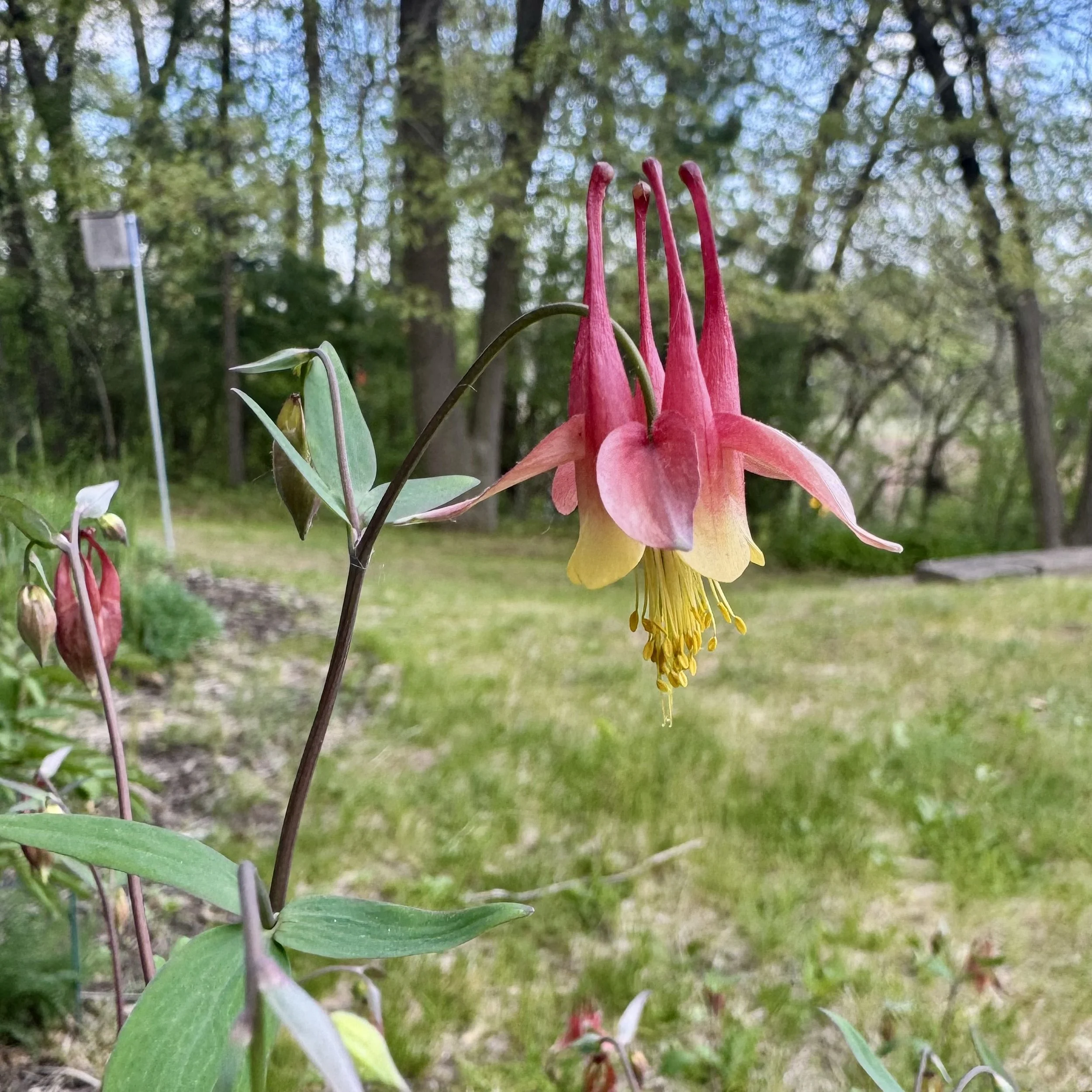
Glockeblumm ‘columbine’ (Aquilegia vulgaris)
There’s something magical about the Glockeblumm. The flowers sway gently in the breeze like tiny lanterns or bells, which explains why we Pennsylvania Dutch call it “bell flower.” There are, in my opinion, even better names for columbines regionally in the United States. Here in Wisconsin, they call them “firecrackers,” a lively and fitting name for the bright blossoms. But my favorite dialect names come from New England: “rock bells,” “five crimson doves,” and “meetinghouses.” Each name captures not only the appearance of the flowers, but also something of the communities and imaginations of the people who loved them.
People love the Glockeblumm on both sides of the Atlantic. There are Old and New World varieties with the Old Word varieties coming into Pennsylvania from, among others, the Moravians in the 18th century. Apothecary and printer Christopher Sauer (1721–1784) cultivated the European Glockeblumm in his own garden and valued it as medicine and ornament.
As I admire the columbines blooming in my garden now, I find myself thinking back to childhood. Some of my happiest memories are of wandering into the woods with a stack of nature books tucked under my arm. I am happiest as a curious person and would spend hours trying to identify every bird and plant I saw and learn more about them, not to catalog them, but to tie together names, colors, smells, movements. To learn the name of a bird or flower is to begin a relationship with it. A treasured possession is my old bird book, inscribed by my mother in careful handwriting and dated May 13, 1989, when I was a wee six years old. Even now, opening its worn pages brings back the excitement of discovery.
This all reminds me of the poem “Learning the Names” by Mennonite poet Julia Spicher Kasdorf. Its about learning to know nature and spending time with her father. She writes: “Sunday afternoons we learned to love nature by naming it.” Glockeblumme are certainly pretty blooms in my garden, but they connect to memory, folk tradition, poetry, and more. Make some time to learn to know and love nature by naming it for a start, then get more curious. Listen to the birds, trace the petals of the wildflowers with your eyes, and perhaps pick up a book of poetry along the way. I highly recommend reading Julia’s poem “Learning the Names” in her collection Eve’s Striptease.
And for anyone interested in Christopher Sauer’s columbines in his herbal, check out the new edition translated and edited by William Woys Weaver: Sauer’s Herbal Cures: America’s First Book of Botanic Healing.